The CWC is beginning a transition to digital-only distribution of our newsletter, and we want to be able to reach you with news and action requests. Please take a minute and join our email list!
Click here to join:
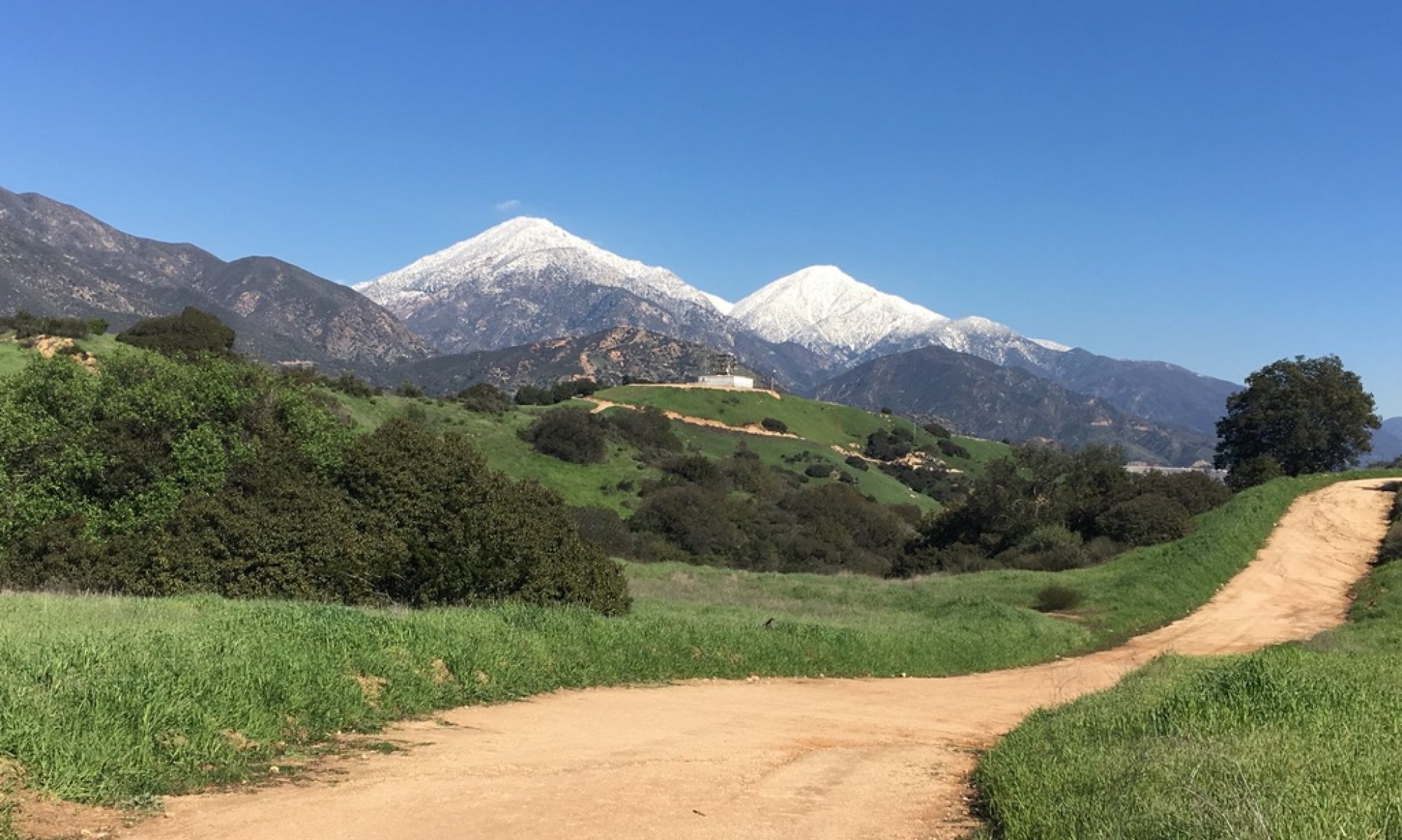
Preserving Our Hillsides
The CWC is beginning a transition to digital-only distribution of our newsletter, and we want to be able to reach you with news and action requests. Please take a minute and join our email list!
Click here to join:
The CWC continues to work to acquire and preserve hillsides properties. Please click the link below to help fund these preservation efforts.
Thank you for your continued support!
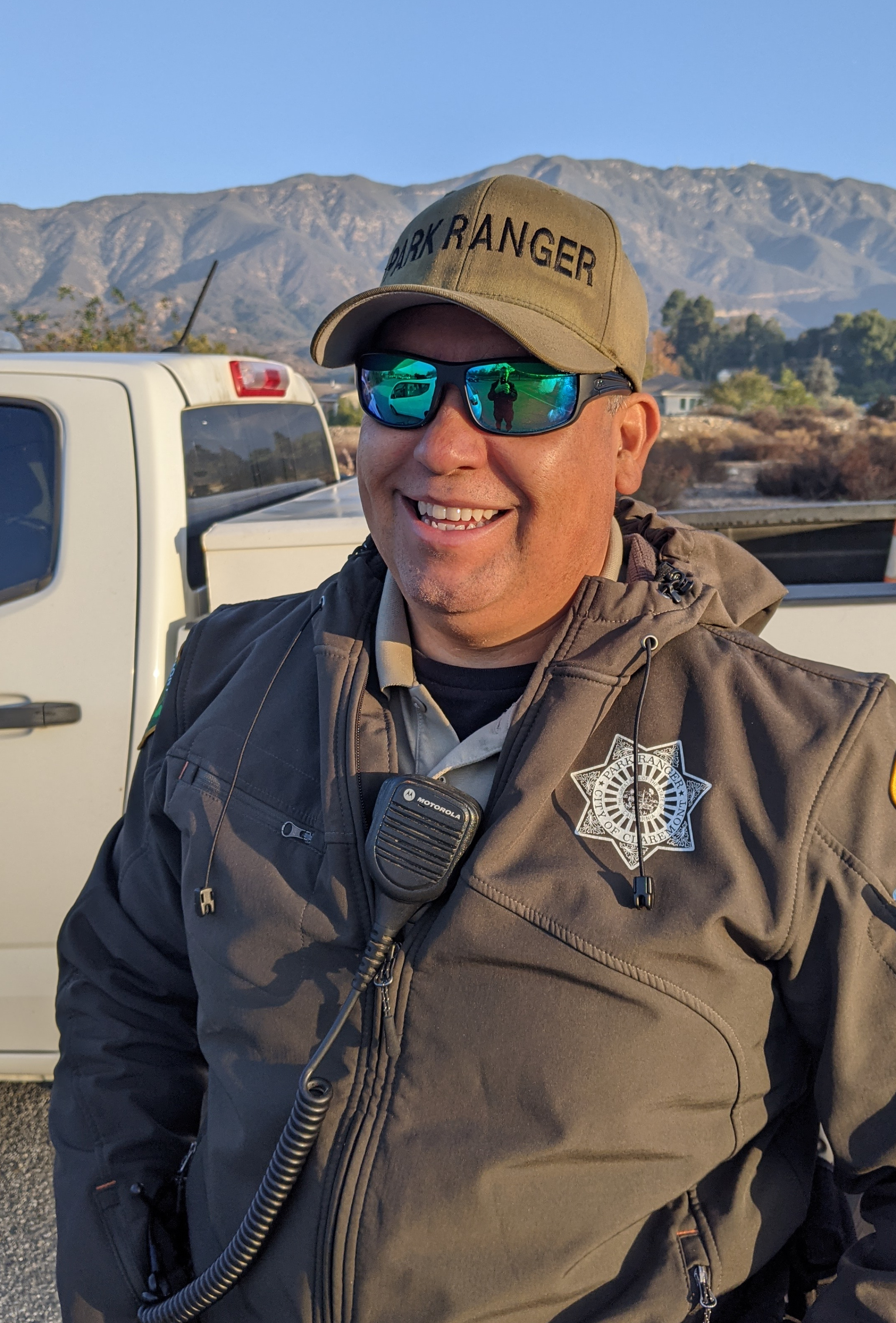
CWC Board Member John Norvell met Senior Wilderness Park ranger Jaime Torres at the Mills Ave. Park entrance and chatted about the COVID-19 pandemic and its impact on the Park and its visitors. Jaime has been a CHWP ranger for eight years, senior ranger for five.
JN: What are the aspects of being a ranger here in this park that you like the best?
JT: I think the interaction with people. We encounter so many different people every weekend that I’m out here. So I think the interaction with people and that’s really what makes this very good.
JN: What would you say have been the most challenging aspects of being a ranger in the CHWP during the COVID-19 pandemic?
JT: I think the most challenging would have to be the enforcement of certain rules that apply to the pandemic only: mask use, one-way trail hiking. You know, I think those are the greatest challenges. Having to enforce the mask rule was a real challenge for the rangers, having to stand at the front gate was a real challenge. But with that said, the cooperation that we got from the visitors was probably 90% or thereabouts, and that was pretty impressive to see.
JN: Yeah that’s more than lots of places.
JT: That’s more than lots of places and with minimal resistance. We didn’t have to get the police involved. We didn’t have to get any other groups involved and it was basically just the rangers. We’re able to communicate with people and just asking them to please abide by this rule. And we got very good cooperation, but it was very challenging to do that.
JN: What would you say the park meant to people when it reopened, because it reopened with those rules fairly early on, right?
JT: Yes. So I think with the Park being open, what that meant to people was the freedom to go out and explore. You know, a lot of other places were still closed. Most gyms at that time were still closed, other facilities were closed, so that’s what that meant to people, in my opinion: the ability to be able to get out of their houses and frequent the place where they can come out and do some exercise. So the City having this park open as a resource to these people who were stuck at their houses, it was huge. And I think that’s also part of the reason why they were so compliant to our requests to come out here and keep their distance from other people, one-way trekking, put your mask on—I think they understood that as long as they followed these rules, the park would remain open, which is a lot of help to us.
JN: Can you think of a specific example of somebody having a really good experience in the Park during the pandemic?
JT: Yeah, I think what I noticed is the people that had medical conditions, those people came to us and said, hey, thank you for being out here. We really appreciate you guys doing this. And they would disclose that they would have a certain medical condition and that they were concerned about being out here. So us rangers being out here and enforcing those rules, it really provided them a sense of, not necessarily security, but they felt better about being out here knowing that we were trying enforce the rules.
During those times, we experienced high numbers of visitors. A lot of the rangers, we spend most of our time educating people. During those times, we also had a lot of new visitors that were never familiar with the Park, or the rules of the Park, you know, stay on the marked trail, and so on. Don’t go off trail, dogs have to be on leash. So, we know there have been a lot of new visitors. They were not aware of the rules of the Park. So we also spent a lot of time enforcing not only the mask rules but also the regular, everyday rules. We still catch a lot of people that are going off trail. We still catch a lot of bikers that are, you know, doing damage to the trail. And I think that’s going to be an ongoing occurrence as long as the Park remains open.
To see the YouTube virtual presentation of the Preservation Award, click on the following link:
City Receives 20-acre Parcel to Expand Wilderness Park
January 13, 2021 1:52 PM
The city of Claremont received a gift of 20 acres of land in the hills east of Webb Canyon, according to the city manager’s weekly update. The parcel, which was donated by Arthur and Susan Bertolina, will be preserved as open space.
“The city has had a long-standing commitment to preserving open space in our hillsides. I would like to thank the Bertolina family for their generous gift, which ensures more of our wilderness corridor remains preserved,” Acting City Manager Adam Pirrie said.
The parcel, which is appraised at $300,000, is bounded by three privately owned parcels to the north, west, and south and is adjacent to the Claremont Hills Wilderness Park on the east. While the city issued a news release about the gift dated December 21, it was just announced Friday.
“The city would like to thank the Claremont Wildlands Conservancy for its role as a liaison between city staff and the Bertolinas throughout the negotiations and for its significant contribution to the costs of the transaction,” city officials said in a statement.
Terry Grill, president of the Claremont Wildlands Conservancy thanks the Bertolinas and congratulates the city for the project’s success.
“We are grateful to the Bertolinas for contributing this valuable open space to the Wilderness Park,” she said. “This addition is one more step toward our vision of extending the park westward from Johnson’s Pasture so that it links up with Marshall Canyon, helping to form a continuous wildlands corridor along the face of the San Gabriel foothills as far as Monrovia. And we commend our city, which supports efforts to expand the parkland in our hillsides and manage it effectively.”
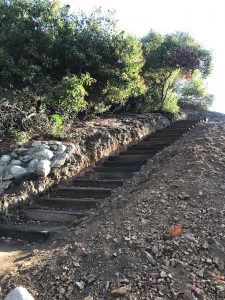
Good News! Restoration work has begun on the Sycamore Canyon portion of the CHWP. Phase 1 has been completed with the reconstruction and relocation of the stairs at the trailhead near the Thompson Creek Trail.
Phase 2 will focus on the rest of the trail, including the addition of “landing pads” on switchbacks. The hope is to get this second phase completed before the end of this fiscal year.
Phase 3 will address erosion. This will be ongoing and will include the Friends of the Wilderness Park and the help of Scouts and reserve Rangers.
~Meg Mathies is a CWC Board member and a volunteer with the Friends of the Wilderness Park.
(This article appeared in our 2020 newsletter, The Post. The full newsletter is available here: https://www.claremontwildlands.org/wp-content/uploads/2020/12/The-Post-Nov2020-web.pdf). Contact us here to be added to our mailing list: info@claremontwildlands.org.)
The Claremont Hills Wilderness Park is a great place for volunteer and citizen scientists to explore and learn about Southern California’s native plant and animal species. Within the park there is an abundance of invasive, nonnative species. These can often disrupt native habitats. An important focus of the Claremont Hills Wilderness Park Master Plan is monitoring the natural environment to ensure that native and sensitive species survive and minimize the introduction and spread of nonnative species.
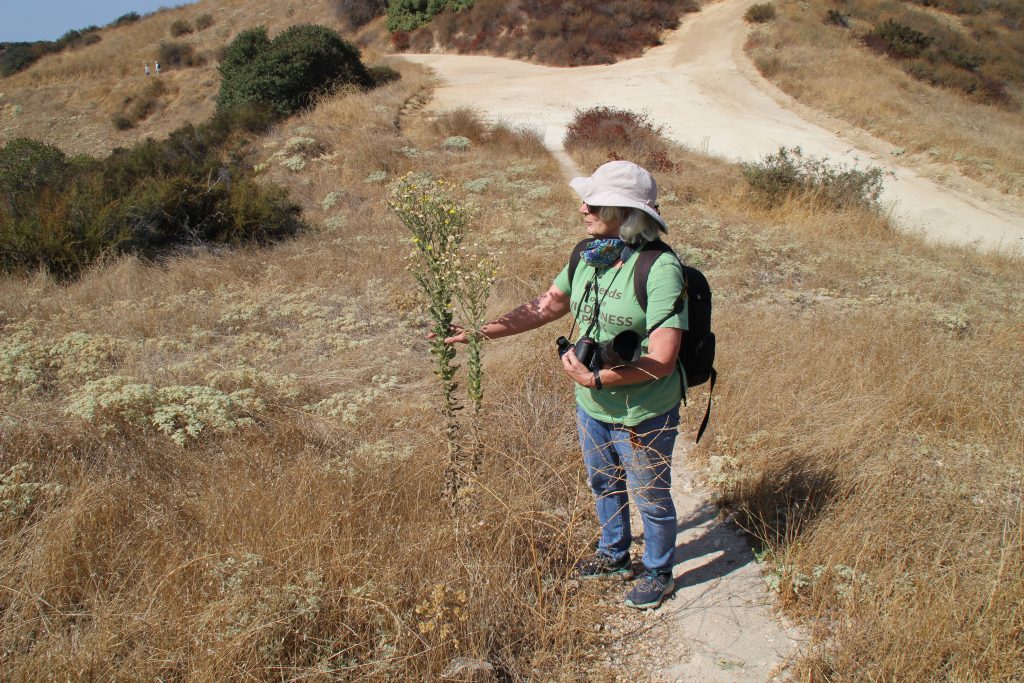
Nancy Hamlett, a retired professor of biology and a longtime resident of Claremont, is piloting two collection projects with the Friends of the Wilderness Park (FWP), the citizen support group established in the Master Plan. She and the FWP have created a collection project using an online network tool called iNaturalist. The project, called “Biota of the Claremont Hills Wilderness Park,” focuses on everything that lives in the park. So far, this project has documented nearly 1,200 observations and 358 species. A second CHWP collection project, using Calflora, another networked online application, is called “concerned with weeds”; its name speaks for itself. These online networks are helpful tools that allow us to combine our efforts in the Park and provide a mechanism to help scientists and naturalists share information. They have mobile phone apps that make it easy to upload photographs and quickly record observations.
Nancy’s work also includes finding and documenting sensitive species within the park, such as the crotch bumble bee (Bombus crotchoii). This bee is one of many species that have suffered a decline in population; it is now listed as a candidate endangered species. To bring awareness to its plight, California Department of Fish and Wildlife’s website featured a photograph of the crotch bumble bee taken by Nancy in the CHWP, their “photo of the month” for February 2020.
In addition to her work with the Friends of the Wilderness Park, Nancy has been the volunteer coordinator and webmaster for the Claremont Colleges’ Bernard Field Station for over ten years. Nancy’s knowledge and tireless volunteer work is invaluable to the CHWP and the City of Claremont.
~Vicki Salazar is a CWC Board Member and volunteer with the Friends of the Wilderness Park.
Next Tuesday, Dec. 3, is “Giving Tuesday.” This is a great opportunity to show your support for the Claremont Wildlands Conservency and our efforts on behalf of the Claremont Wilderness Park with your tax deductible donation. Simply click on “Donate to the CWC” and use PayPal or print the donation form and mail it in.
Interested in hearing a quick update? Come to the T. Willard Hunter Speakers Corner at Memorial Park on July 4th from 12:20 – 12:30 to hear Terry, Ali, Meg and Vicki. Happy Independence Day.