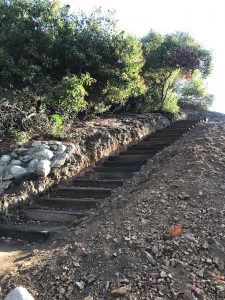
Good News! Restoration work has begun on the Sycamore Canyon portion of the CHWP. Phase 1 has been completed with the reconstruction and relocation of the stairs at the trailhead near the Thompson Creek Trail.
Phase 2 will focus on the rest of the trail, including the addition of “landing pads” on switchbacks. The hope is to get this second phase completed before the end of this fiscal year.
Phase 3 will address erosion. This will be ongoing and will include the Friends of the Wilderness Park and the help of Scouts and reserve Rangers.
~Meg Mathies is a CWC Board member and a volunteer with the Friends of the Wilderness Park.
The Claremont Hills Wilderness Park is a great place for volunteer and citizen scientists to explore and learn about Southern California’s native plant and animal species. Within the park there is an abundance of invasive, nonnative species. These can often disrupt native habitats. An important focus of the Claremont Hills Wilderness Park Master Plan is monitoring the natural environment to ensure that native and sensitive species survive and minimize the introduction and spread of nonnative species.
Nancy Hamlett, a retired professor of biology and a longtime resident of Claremont, is piloting two collection projects with the Friends of the Wilderness Park (FWP), the citizen support group established in the Master Plan. She and the FWP have created a collection project using an online network tool called iNaturalist. The project, called “Biota of the Claremont Hills Wilderness Park,” focuses on everything that lives in the park. So far, this project has documented nearly 1,200 observations and 358 species. A second CHWP collection project, using Calflora, another networked online application, is called “concerned with weeds”; its name speaks for itself. These online networks are helpful tools that allow us to combine our efforts in the Park and provide a mechanism to help scientists and naturalists share information. They have mobile phone apps that make it easy to upload photographs and quickly record observations.
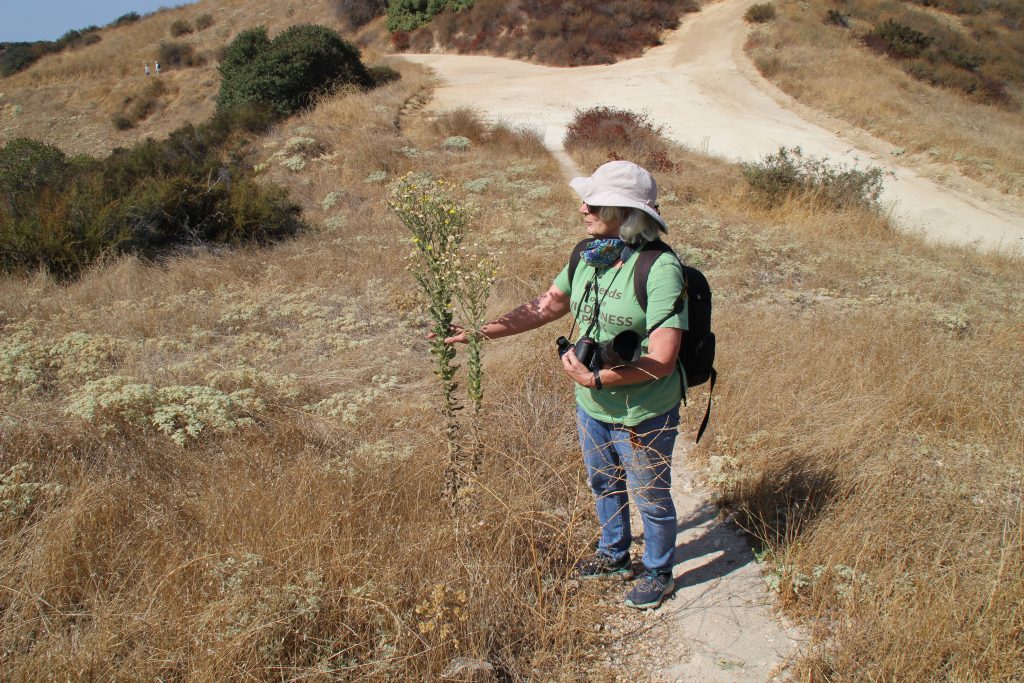
Nancy Hamlett documents plants in her CHWP project. (Photo credit: Vicki Salazar)
Nancy’s work also includes finding and documenting sensitive species within the park, such as the crotch bumble bee (Bombus crotchoii). This bee is one of many species that have suffered a decline in population; it is now listed as a candidate endangered species. To bring awareness to its plight, California Department of Fish and Wildlife’s website featured a photograph of the crotch bumble bee taken by Nancy in the CHWP, their “photo of the month” for February 2020.
In addition to her work with the Friends of the Wilderness Park, Nancy has been the volunteer coordinator and webmaster for the Claremont Colleges’ Bernard Field Station for over ten years. Nancy’s knowledge and tireless volunteer work is invaluable to the CHWP and the City of Claremont.
~Vicki Salazar is a CWC Board Member and volunteer with the Friends of the Wilderness Park.